
The Padel Grip Myth for Beginners: Why You Only Need One Grip (The Continental) for Your First 6 Months
The logic seems sound: the more grips you learn, the better and more advanced you become. But in the fast-paced, glass-walled world of padel, this approach often wrecks your first six months of learning.
If you are a beginner, trying to rotate your racket between a forehand grip and a backhand grip will cause frustration, inconsistency, and confusion. The simple truth? For now, you only need one master key - the Continental Grip - to unlock 90% of the game.
Continental: The Master Key to Padel Consistency
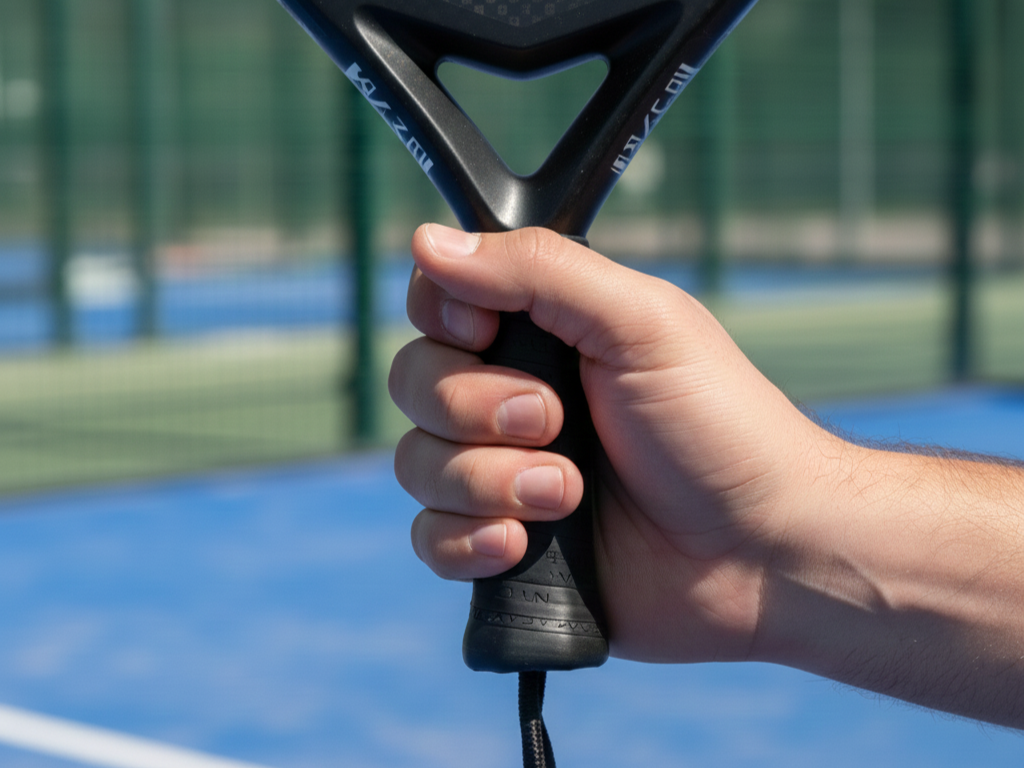
Coaches across the globe describe the Continental Grip as the foundation of padel for a reason. It is often called the "Hammer Grip" because you hold the racket as if you are hammering a nail directly into the end of the handle.
Simple Checkpoints:
The "V" Position: Hold the racket so the "V" shape created between your thumb and index finger sits exactly along the top bevel of the handle.
Racket Face: When you are in your ready position, the racket face should be roughly vertical.
Pressure: Maintain a light, relaxed grip. Holding too tight (the "Death Grip Syndrome") causes stiff swings and prevents the small, necessary wrist adjustments.
Three Reasons One Grip Beats Many for Beginners
By committing to the Continental Grip for your first six months, you immediately solve the biggest beginner pain points:
Faster Reaction Time: Not changing grips means you have zero setup time at the net. You can instantly handle both forehand and backhand volleys, which is crucial for surviving fast exchanges.
Simpler Learning Curve: You can invest your mental energy and cognitive load where it matters: reading the glass walls, positioning, and decision-making. You stop worrying about hand positions and start learning where to hit the ball.
Future-Proof Fundamentals: The Continental is the correct grip for volleys, bandejas, and defensive lobs. Sticking with it now lays the rock-solid base needed to smoothly transition into more advanced overheads later.
Drills to Lock In Your One Grip
Commitment requires practice. Use these simple drills to make the Continental Grip feel natural and automatic:
Wall-Only Rally: Stand a few metres from the wall. Your goal here is to focus purely on the feel of the grip, not power. Rally slowly using only the Continental Grip, aiming for 20–30 controlled, soft hits without changing your hand position once. Focus on feeling the same stability on both the forehand and backhand sides.
Volley Line Drill: Stand at the net. Have a partner feed gentle balls and hit compact volleys, alternating forehand, backhand, and back to forehand. The key technical focus here is maintaining a "quiet wrist." The power should come from your legs and body rotation, not your arm or wrist twisting the handle.
Midpoint Grip Check: This is a crucial habit to build. Between every point, or before every serve and return, consciously check that your hand is correctly placed on the handle (the "hammer" position). This creates a vital routine that prevents you from unconsciously drifting back into old tennis habits.
Give yourself six months of absolute commitment to the Continental Grip. This single hack will speed up your learning, clean up your technique, and build a consistent base. Once that base is solid, then, and only then, can you start adding nuance.
