
5 Padel-Specific Exercises to Bulletproof Your Ankles and Shoulders
Padel is fast, explosive, and addictive – which is exactly why it beats up your ankles and shoulders if you don’t prepare your body properly. Building a simple “prehab” routine around these two joints can dramatically reduce your risk of sprains, tendinopathies, and nagging overuse pain, while also making you feel lighter and more powerful on court.
This article breaks down five padel-specific exercises you can plug into your warm‑ups or gym sessions to “bulletproof” your ankles and shoulders so you can play more, hurt less, and keep improving season after season.
Why ankles and shoulders take a beating
Padel loads your ankles with constant lateral shuffles, split-steps, lunges and decelerations, often on grippy courts that punish any awkward landing or late change of direction. At the same time, your shoulders absorb endless serves, bandejas, viboras and smashes, usually with the arm in an overhead or rotated position that stresses the rotator cuff and shoulder blade muscles.
Most recreational players work on strokes but neglect the small stabiliser muscles and balance systems that keep these joints safe. That gap is where preventable sprains, tendon pain and “mystery” shoulder aches creep in – and where smart, targeted exercises make the biggest difference.
How to use this routine
Frequency: 2–3 times per week, or 10–12 minutes as a pre‑session activation.
Equipment: A resistance band, a step/box, a light dumbbell or plate, and a little floor space.
Structure: Perform all five exercises as a circuit (1–5), rest 60–90 seconds, then repeat 2–3 rounds depending on your level.
You can also cherry‑pick one ankle and one shoulder drill as a mini warm‑up before stepping on court.
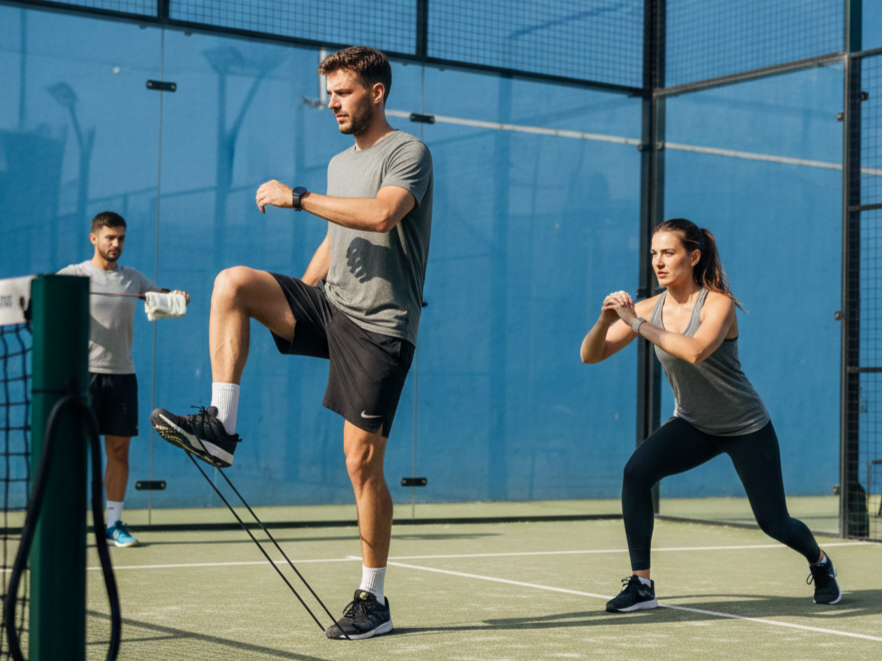
Exercise 1: Single‑leg balance with reach (ankle stability)
This drill trains your ankle to react to the kind of micro‑losses of balance you see when you slide, brake, or stretch for a ball on one leg. It also wakes up the small stabilisers around the foot and hip that help control your knee position during lunges and direction changes.
How to do it:
Stand on your right leg with a slight bend in the knee, left foot off the floor.
Maintaining balance, reach your left foot forward, out to the side, and slightly behind you in a controlled “clock” pattern, lightly tapping the ground each time.
Keep your standing heel rooted and your knee tracking over your toes.
Perform 8–10 reaches, then switch legs.
Padel-specific coaching cue: Visualise this as defending a sharp angled volley, then pushing back to centre – your ankle should feel “alive” but not collapsing inwards. Progress by doing it on a pad, folded towel, or even with a partner gently nudging your shoulders.
Exercise 2: Lateral lunge to drive (ankle strength + deceleration)
The lateral lunge mimics the exact pattern you use when you push off the T, load one leg wide, then drive back to recover. Training that pattern under control helps your ankles handle the braking forces and reduces the chance of rolling when you arrive late to the ball.
How to do it:
Stand tall, feet wider than hip‑width, toes pointing slightly out.
Step to the right, bend your right knee and sit your hips back into a side lunge, keeping the left leg straight.
Pause for a second in the loaded position, feeling your right hip, glute and ankle work.
Push the floor away and drive explosively back to the centre, returning to the start.
Do 8–10 reps on one side, then 8–10 on the other.
Padel-specific coaching cue: Think “arrive, absorb, explode”. This is your preparation for sudden wide balls off the side glass or fast low volleys into the corner.
Exercise 3: Ankle mobility rocks (pain‑free range for lunges)
Strong ankles are great, but if they lack mobility you’ll overload your knees and hips during deep lunges and low defensive shots. This simple drill improves dorsiflexion (knee over toes), making it easier to get low, stay balanced and push back out of stretched positions.
How to do it:
Half‑kneel facing a wall with your front foot about a hand‑width from the wall.
Keeping your heel flat, gently drive your front knee towards the wall until it touches, then rock back.
Explore slightly inwards and outwards angles to mimic real padel foot positions.
Perform 12–15 controlled rocks per leg.
Padel-specific coaching cue: Match the stance you use when lunging into the corner or hitting a low backhand after the back glass. Over time, you should notice less “pull” in your Achilles and easier depth in your split‑steps and lunges.
Exercise 4: Resistance band external rotations (rotator cuff armour)
Your rotator cuff is the group of small muscles that keeps the ball of the shoulder centred in the socket during high‑speed swings. If it’s weak or fatigues quickly, your bigger muscles (like the deltoid) compensate, and that is when pinching, soreness and “dead arm” sensations start to show up.
How to do it:
Attach a resistance band to something stable at elbow height.
Stand side‑on to the anchor, hold the band in the hand furthest from it.
Tuck a rolled towel between your elbow and ribs, elbow bent to 90 degrees.
Starting with your forearm across your stomach, rotate your arm outwards, keeping elbow pinned to your side, then return with control.
Perform 2–3 sets of 12–15 reps per arm.
Padel-specific coaching cue: Think of this as “preloading” the shoulder for bandejas, viboras and overhead smashes. The goal is smooth, burn‑y control, not max resistance.
Exercise 5: Kneeling landmine or single‑arm press (shoulder stability overhead)
Overhead shots in padel rarely happen in a perfect, straight‑up position; they’re usually a bit in front or to the side, with the trunk rotating. A landmine‑style or slight‑diagonal press builds strength and control in that “functional” angle, while the kneeling position forces your core and hips to stabilise, just like when you set up under a lob.
If you don’t have a landmine:
Use a dumbbell or plate.
Press on a slight diagonal instead of straight overhead.
How to do it (landmine version):
Kneel on one knee (half‑kneeling) with the opposite hand holding the bar or weight at shoulder height.
Brace your core, squeeze the glute of the back leg, and press the weight up and slightly forward on a diagonal.
Pause briefly at the top, then lower with control.
Perform 3 sets of 8–10 reps per side.
Padel-specific coaching cue: Imagine you are tracking a lob and finishing a controlled bandeja rather than an all‑out smash. Prioritise smooth control and rib‑cage stability over heavy load.
Putting it all together: sample “bulletproof” routine
Pre‑padel warm‑up (8–10 minutes):
Ankle mobility rocks: 1–2 sets of 10–12 per leg
Single‑leg balance with reach: 1 set of 6–8 reaches per leg
Band external rotations: 1–2 sets of 12 per arm
Off‑court strength session (15–20 minutes):
Lateral lunge to drive: 3×8 per side
Kneeling landmine/single‑arm press: 3×8–10 per side
Finish with 1 extra round of single‑leg balance + band rotations as a “stability finisher”.
